
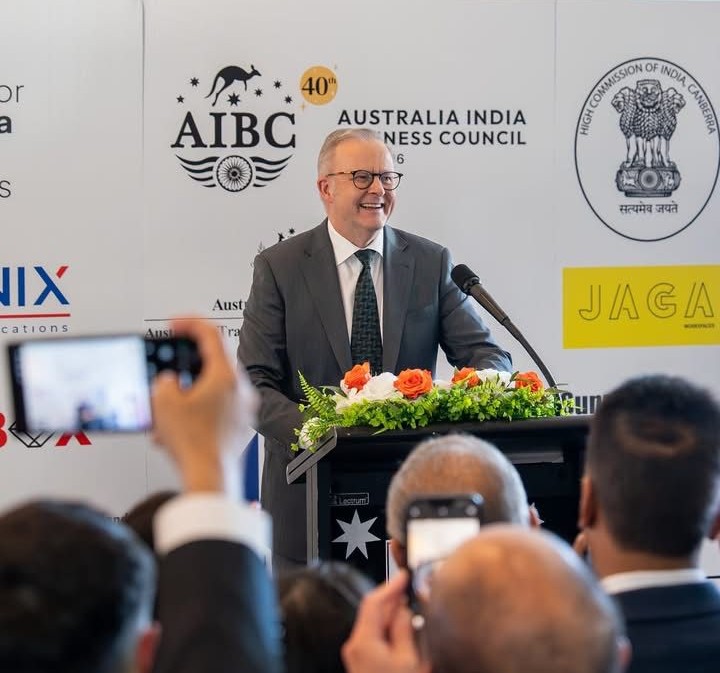
Thank you very much, my dear friends.
I begin also by acknowledging the Traditional Owners of the land on which we’re meeting and pay my respect to elders past, present and emerging.
As I look out here, I hope there is not a vote in the Parliament, because I think I have most of my Caucus here. Even with a majority in the Parliament, I don’t think we’ll have it if the bells ring.
But that says something about the importance of the relationship between Australia and India, and also the relationship that my government has with the Indian Australian population.
I would particularly like to acknowledge the CEO of the AIBC, Deepak-Raj Gupta OAM. I also acknowledge the Deputy High Commissioner of India, Irina Thakur. And, of course, all my colleagues from across Parliament.
What a wonderful anniversary this is.
For an organisation to last 40 years is never simply the dividend of good luck. It is hard work. It is the result of the ambition, determination, dedication and the sheer hard work of an entire army of people.
It’s a story that began with a vision born out of the recognition of the need to strengthen the bonds between our two nations.
Both extraordinary in such different ways, both brought together in a close partnership that has come to be defined by flourishing economic, strategic and community ties, and given its greatest through the friendship that, in all its mutual admiration and respect, constitutes the beating heart of our relationship.
Forty years after that vision was turned into reality by two giants – Prime Minister Bob Hawke and Prime Minister Rajiv Gandhi – it gives me such pleasure to celebrate your ongoing success, and to acknowledge the importance of what you do.
One of the most timeless statements anyone can ever utter is that there is no greater time to engage economically with India than now.
It is, of course, the most populous country in the world. It is a strong and dynamic democracy. It is on track to be the third largest economy by the end of this decade. And the way India’s economy is growing is, in so many remarkable ways, complementary to our own. Add to that all that connects us culturally and through the powerhouses of education and sport, not least the international language of cricket.
I will never forget very early on in my prime ministership attending the fourth Test there at the Narendra Modi Stadium there in Gujarat, and going around that stadium in the chariot, which I’m sure all of you have seen. And as we went around in that chariot, and everyone was there, were more mobile phones than we have here.
There were about 80,000 being held up as we went around.
And I said to my friend Prime Minister Modi, ‘you’re very popular’, as people were cheering out. And he said to me, ‘they’re cheering for you’. I said to him, ‘that’s nice of you, Prime Minister,
but they don’t know who I am’, to which he pointed to the sightscreen that had a big photo of me on it, and the banners that went from, they must have been as tall as this building, 18 metre banners of Albanese, Modi, Albanese. He said, ‘they do now’.
And it said something about the generosity of spirit between Australians and Indians, the effort that went into that extraordinary visit that I had, one of the first visits that I had as Prime Minister, one of the two visits that I’ve had now as Prime Minister. But of course, I have had many more visits to India prior to becoming Prime Minister.
As Mr. Gupta said, my first visit he said it was similar between 1991 and Prime Minister. I can assure everyone here that it was very different.
As Prime Minister, you get the roll gold treatment.
In India, when I backpacked around India, which included train rides, which were fantastic.
The video bus rides are a mix of my affections. Affection that I survived, but fear at the time, because at the time there were, as you went along, you weren’t so much watching the video, which, of course, was in Hindi, and my Hindi is limited.
There were cars on the side of the road the whole way. It was full on, and it was an absolutely delightful visit.
We decided after deciding that the video buses were a bit full on overnight, that we’d hitch a ride. And we hitched a ride, I think it was from Jaipur to Udaipur or somewhere in, in that, that part of the world.
I also went to Jaisalmer.
I went on a camel safari.
So, I travelled through all the modes of transport in India, but I got to know people. It’s how you get to know people, and when I say for my colleagues – if you want to visit India, forget the High Commission and what they’ll tell you to do. Get on a train, get on a train, and you will get to meet Indian people, and you will be fed, and you’ll be told stories, and you’ll be welcomed.
And I was welcomed into homes from people who we didn’t know, just met us. And it was probably less common to see Australians on a trip like that.
When we went into Jaisalmer, which most of our Indian friends will be, of course, very familiar with, but some of the Australian friends possibly not – it’s in the desert, and its old up on the hill, is basically an old fort type city, and there was no one on the street.
And everywhere you go in India, one of the things that you find, it’s very hard to be alone. There’s a few people there. And so we’re there, and we’re wondering, ‘gee, this is really quiet place’, and then it went from there being zero people to hundreds of thousands of people in literally a minute – the lunch break in the Test Cricket.
Everyone had been watching the Test, and as soon as the lunch break came, they all came out and were playing thousands of cricket games just on the street.
We splurged. We stayed in some very cheap places. We splurged, so staying at the Lake Palace Hotel at Udairpur, and that was – we rocked up, and you can negotiate in India as well, I remember saying, ‘this is how much dollars we have. If you let us stay, we’ll give you the equivalent of $20 for something’, and we got away with it.
So, it was a wonderful trip.
And since then I’ve been back to India many, many times.
And I led a delegation there just before I became Leader of the Labor Party, I think it was in 2018. And there, our High Commission freaked out completely because I insisted on going to the Temple in Akshardham, and going by myself on the train, and doing all that while some of the delegation went off to the Taj Mahal, because I’ve been, and I really wanted to see, actually, this amazing Hindu temple there, just outside of Delhi.
And you can catch the Metro there, and then walk all the way through. And as you walk, if you’re going to that temple, and you look like me, you stand out, so it’s a great way to make friends as well.
And around that temple, was explained to me, the meaning of what it was, the spiritual significance of that magnificent temple, and it was a great, it was a great privilege.
The High Commission were completely freaked out about the idea, and my security now wouldn’t let me do it, so I was glad that I was able to do it.
But one of the things I found, above everything else, is the warmth of the Indian people, and that’s the basis, the diaspora here – I want to thank every person who’s proud of the Indian origins has made Australia their home, because you’ve enriched Australia through your presence.
Your entrepreneurship has helped build jobs and helped build businesses in this country. It is that link between our two countries that is so important, so important.
So, when Prime Minister Modi, of course, comes here in a short period of time, for the second time since I’ve been Prime Minister, I’m so looking forward to the engagement with the community, because it is a community without whom modern Australia would be hard to imagine.
It is, of course, the largest growing migration community in Australia.
And I assure you that our position on migration, when it comes to the Indian community, is one of welcoming, welcoming as Australians.
And you will never hear from me a distinction drawn between migrants and Australians.
So, congratulations to the AIBC.
Our economic relationship is growing across so many areas.
On trips, I’ve had the opportunity to look at the image from outside of India, sometimes agriculture, those industries are so important, but in terms of high tech, what you’re doing in places like Hyderabad and these centres, Mumbai, and everywhere right around India is just extraordinary.
You are leading the world in medical research, in use of the things that new developments that will help power the global economy this century, including AI, robotics, and these areas as well.
You have companies that have a big presence here, like Tata and others, that are huge companies on top of what you are doing through small business.
I am particularly pleased that the Centre for Australia India Relations has just signed a contract awarding you a $200,000 Maitri grant to promote business engagement with India.
That is fitting and practical recognition.
Because for 40 years, this organisation has been central to building that relationship.
A relationship that helps India, but also helps Australia.
One that helps build us up as well as partners in the Indian Ocean, of course, of which we are a significant player.
This gives us incredible confidence as we look to the future.
And the fact that I have so many of my Caucus members here from the Labor Party says a lot about how much we value your presence.
I look forward to continuing to engage with the community.
I look forward to welcoming Prime Minister Modi.
I don’t think I’ll be able to give him a chariot around the SCG or the MCG, but I know that it will be a fantastic visit and will be so welcomed by Australians as well.
Congratulations on forty years.