
I had not planned to spend my Sunday noon inside a jail and that too , at the red colour Alipore Jail. Now, it is a museum in the Indian city of Kolkata. But then again, very little in Kolkata goes according to plan, and the city has long since, taught me to be grateful for that.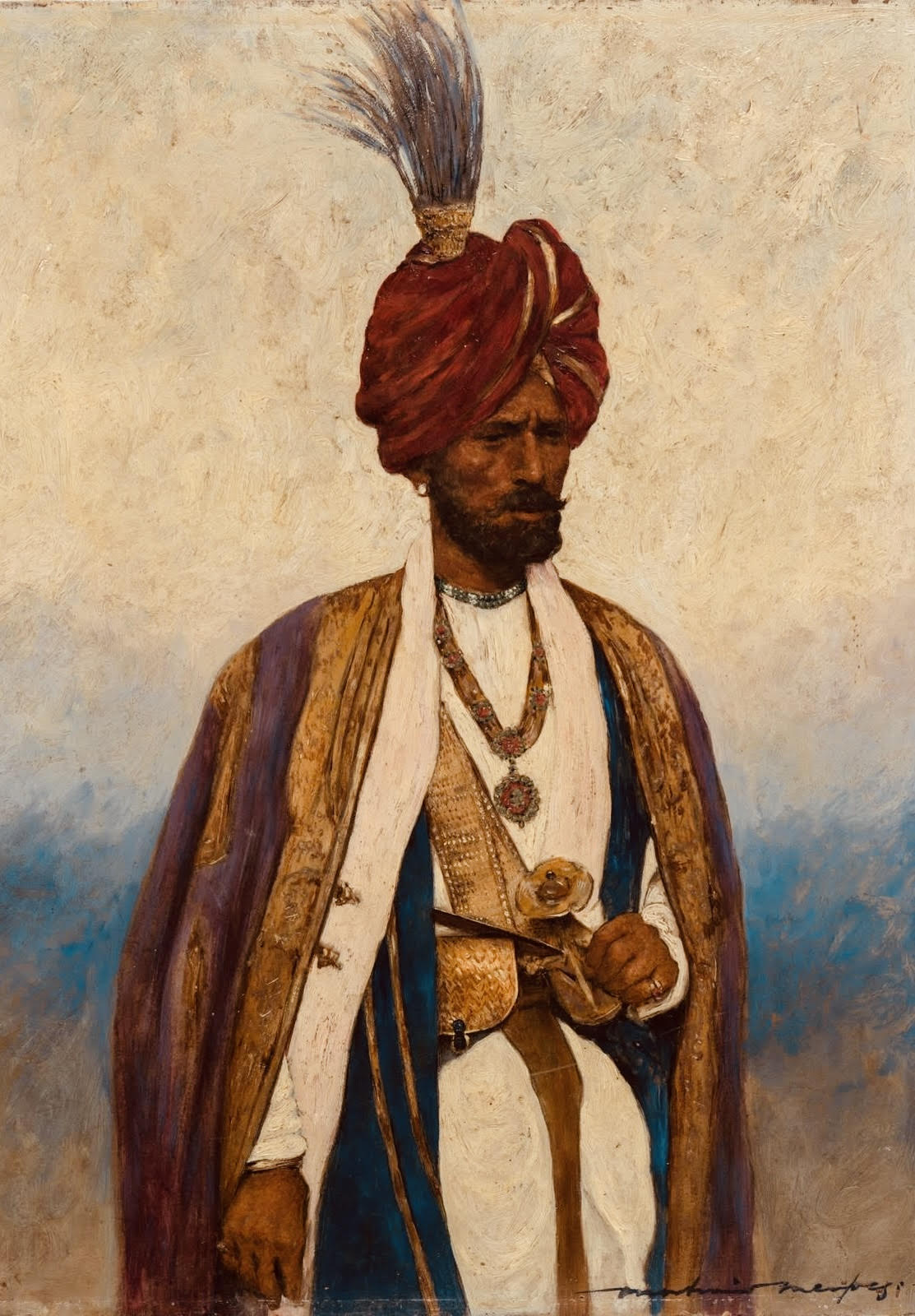
Alipore Jail Museum is where Aurobindo Ghose spent his time with many other freedom fighters who wanted to free Indians from the shackles of British Empire and its cruelty. Cruelty that turned the subcontinent into age of darkness while few foreign artists from America, Denmark , Germany, Holland, Japan and United Kingdom painted a more colourful version of India for the rest of the world.
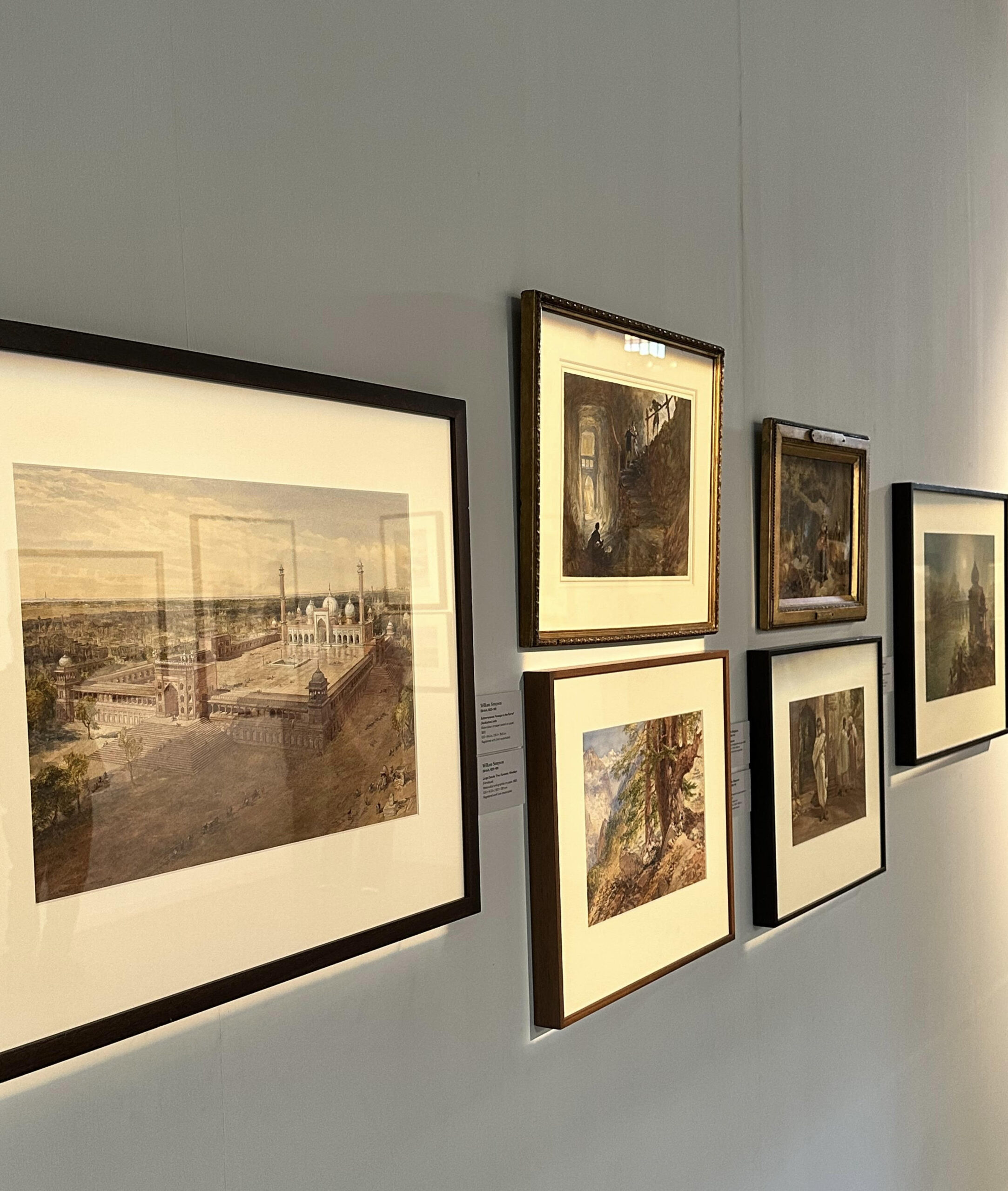
Delhi Art Gallery( DAG)’s ‘Destination India: Foreign Artists in India, 1857–1947’ in collaboration with Alipore Jail Museum is an extremely rare exhibition. Mr. Giles Tillotson guided us through the galleries to enjoy the exhibition. He is someone who has spent a lifetime thinking about how India has been seen, described, and misread, set the terms carefully at the outset. He highlighted artists such as William Simpson, Marius Bauer, Edward Lear, Ernest Stephen Lumsden, Hugo Vilfred Pedersen, Charles William Bartlett, John Griffiths, and Yoshida Hiroshi.How curious they were as they painted India that genuinely moved them during their travelling.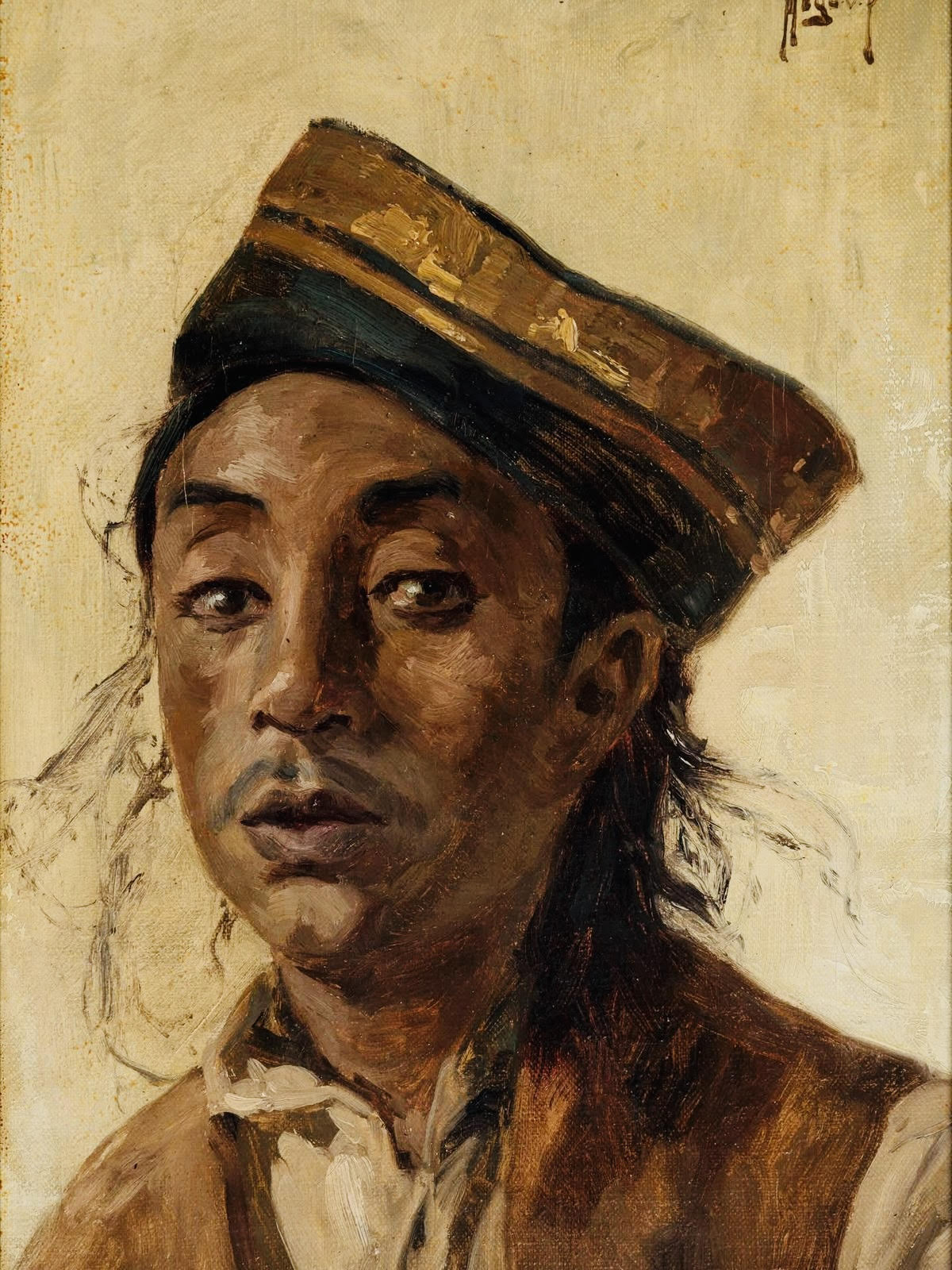
The Danish painter Hugo Pedersen, less known than his British counterparts left behind a body of picturesque Indian portraits. His untitled study of a man from the Himalayas is perhaps the most definitive work in the entire show, a large-format canvas in burnished browns, the young man’s cap sitting loosely atop long dark hair, his expression searching and luminous, rendered with an expressive, almost sketchy confidence that feels startlingly modern. The man simply is, and Pedersen, to his considerable credit, seems to have understood that this was enough.
And then, turning a corner, my eyes caught the Portrait of a Madras Boy. The mood shifts entirely. Close, warm, intimate. The sitter’s deep complexion is anchored by a boldly painted scarlet and gold turban; his gaze is direct and composed, meeting my eyes without deference and performance. It is, in its quiet way, the most radical work Pedersen made in India.
While Mortimer Menpes offers a counterpoint. A Soldier of His Highness Dogra Sowar ( Maharaja of Jammu and Kashmir), a full-length portrait from the magnificent 1903 Delhi Durbar. The soldier stands resplendent, a vivid crimson turban crowned with a feathered plume, a richly embroidered coat of white and gold set against a sweeping blue-grey sky. The pageantry of imperial military life rendered in full, gorgeous, unambiguous colour. It is a portrait of theatre, and Menpes, who was himself a consummate performer, knew exactly what he was doing. Tillotson paused here for a moment longer than elsewhere and it didn’t take me to understand why.
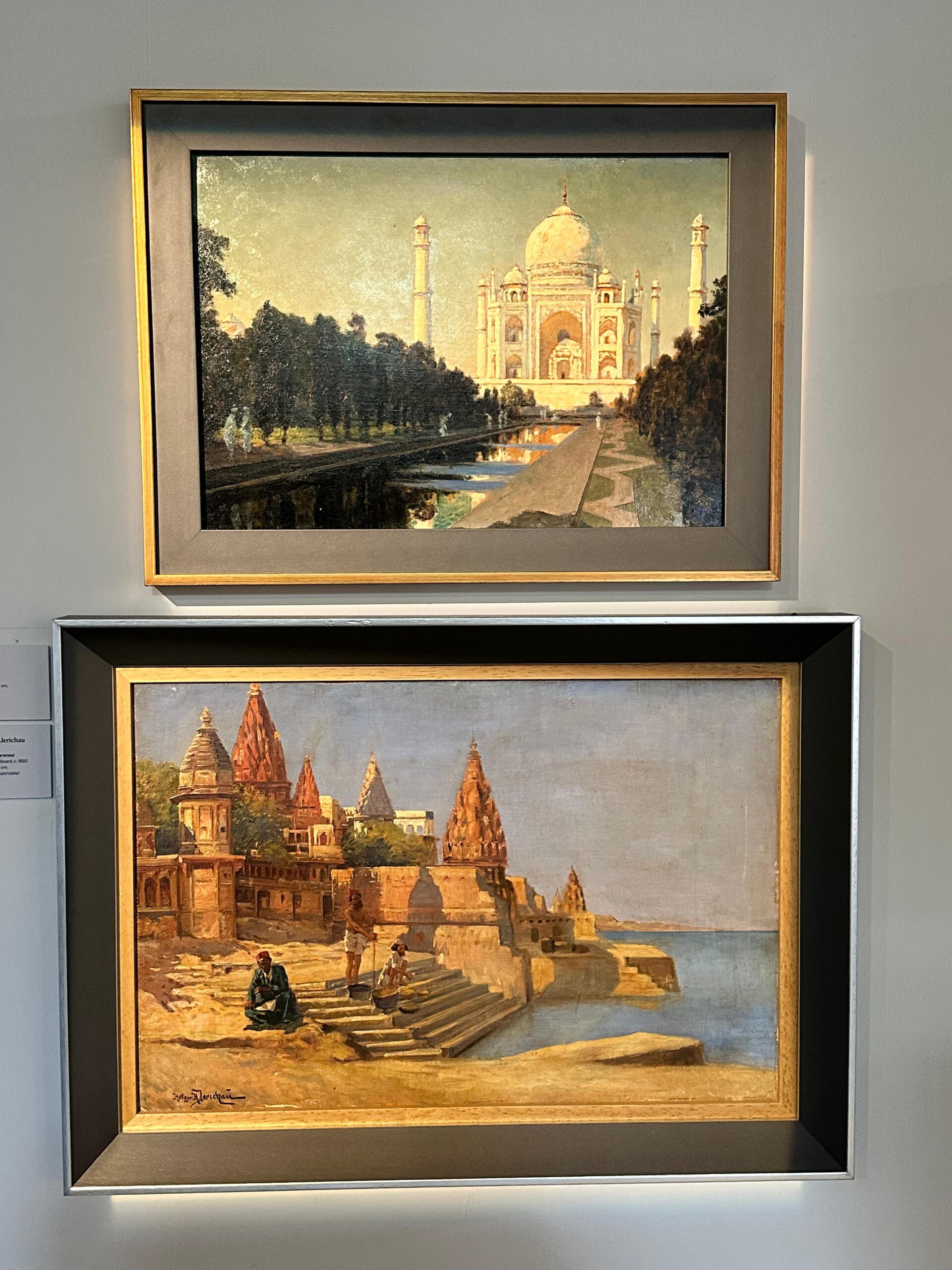
The exhibition also featured landscapes and monuments of India. The accumulated weight of the exhibition becomes something genuinely moving. From the quiet luminescence of the Taj Mahal to the teeming streets of Delhi and Gwalior; from the Golden Temple at Amritsar to the stepped temples of Amer; from the ghats of Varanasi, ancient and indifferent, to the ornate palaces of Jaipur. The painting of Taj Mahal just made me speechless with its artistic simplicity and the sheer beauty it represented.
A celebration of India that was encountered on foot, by rail, and by river as the artists crisscrossed the subcontinent. Observed in its monuments, marketplaces and mountain ranges. The everyday rhythms of an India long lost in time but documented by these paintings in a professional setting. Created by travelling artists who came from overseas and traced a subcontinent that exceeded, in almost every instance, what anyone had come prepared to find. Such is the beauty of India.
Pointing to a particularly luminous view of the Ganges, Tillotson made a logical point that the act of travelling to paint India was itself a kind of argument. These artists came because they believed there was something here worth observing, worth recording, worth understanding. That the understanding was partial, sometimes patronising, sometimes frankly wrong, does not entirely cancel the sincerity of the attempt. It is no wonder that Italian artist and teacher Olinto Ghilardi played a significant role at the Government School of Art in Kolkata during the late 19th and early 20th centuries. He instructed prominent Bengali artists like Abanindranath Tagore and Sashi Kumar Hesh in European techniques, creating an extraordinary world of art that still mesmerises many in the 21st century. I firmly believe that artists like Ghilardi and Lady Canning made Indian city like Kolkata a profound cultural establishment long before any could fathom and acknowledgment. We are definitely lucky for their art. The exhibition was truely remarkable experience for me and I encourage others to enjoy it till 28th of May, 2026.